























Overview
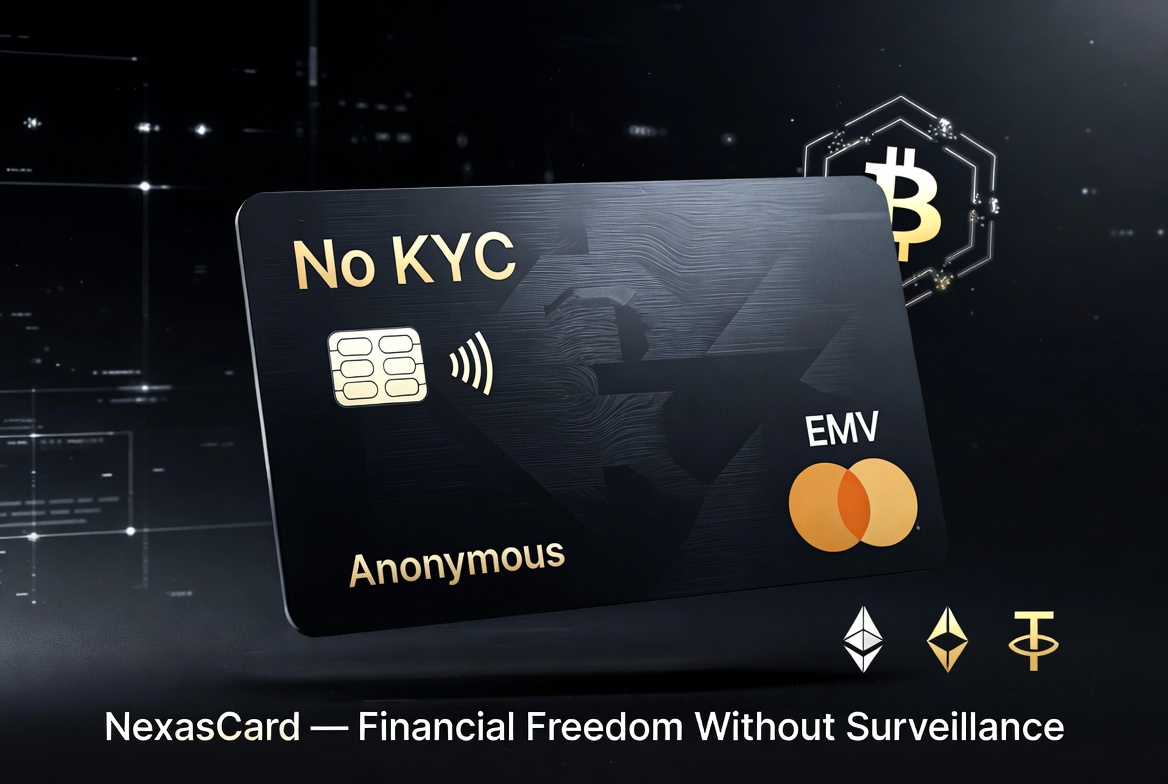
NexasCard pitches itself as a no-KYC credit card for the privacy-minded crypto holder. Launched as a virtual-only service after physical cards were discontinued in early 2025, it promises instant issuance, global Mastercard acceptance, and zero identity verification. Users deposit a minimum $70 balance in cryptocurrency and receive virtual card details within minutes, ready for online purchases, subscriptions, and contactless ATM withdrawals via Apple Pay or Google Pay.
The pricing model is deliberately simple but not cheap: a 6.5% commission on every top-up, with 0% foreign exchange fees and 0% ATM withdrawal fees. Daily spending limits cap at $5,000, with $25,000 monthly ceilings and $500 daily ATM withdrawal limits. For those seeking to bridge crypto into everyday fiat spending without surrendering personal documents, NexasCard occupies a narrow but genuine niche.
Privacy & KYC
NexasCard operates at KYC Tier L2, Discreet, requiring only an email address to register. No passport, no government ID, no selfies, no proof of address. This places it among the more accessible anonymous crypto cards currently available, though "anonymous" carries important caveats.
- Email required: yes
- IP logging: confirmed
- Identity documents: none
- AML compliance claims: explicitly disclaimed on site
The service markets itself as outside traditional AML frameworks, which will alarm compliance-conscious users and attract privacy absolutists in equal measure. However, the IP logging and email requirement mean determined adversaries could potentially correlate accounts. The privacy score of 60/100 reflects this tension: better than centralized exchanges, but far below cash or fully peer-to-peer systems. Users seeking true unlinkability should route access through VPNs and dedicated email aliases.
Supported assets & payments
NexasCard supports a broad roster of cryptocurrencies for top-ups, significantly wider than the three coins listed in legacy directory data. According to current site information, accepted assets now include BTC, ETH, SOL, XMR, USDT, USDC, TRX, BNB, DOGE, LTC, TON, MATIC, BCH, and XRP. This expansion into privacy coins like Monero alongside major stablecoins and layer-1 assets gives users genuine flexibility in how they fund spending.
All deposits convert to card balance at the point of top-up. The 6.5% fee is baked into the exchange rate rather than charged separately, which simplifies accounting but masks true costs. Notably, there are no subscription fees, no recurring charges, and no dormancy penalties, users pay only when funding the card. Virtual cards integrate with major mobile wallets for NFC payments, and 3D Secure is activated for online transactions.
Security & custody
NexasCard operates as a custodial service: user funds sit on the provider's infrastructure, not in self-custodied wallets. This is inherent to any card product requiring real-time authorization against Mastercard networks, but it remains a critical trust assumption. The trust score of 55/100 suggests limited independent verification of reserves, insurance, or operational security.
On the positive side, the service offers free card re-issuance and guarantees platform acceptance, both useful protections against freeze events that plague higher-KYC alternatives. The virtual-only model since January 2025 reduces physical attack surfaces but also eliminates offline backup options. Users should treat card balances as hot-wallet funds: convenient for spending, not for storage.
Who it's for, verdict
NexasCard suits a specific profile: the privacy-conscious crypto user who needs occasional fiat off-ramping without identity exposure, and who accepts a steep 6.5% premium for that convenience. It works best for subscription payments, travel bookings, and moderate ATM withdrawals where traditional exchange KYC would be prohibitive or dangerous.
It is poorly suited for high-volume spenders, the monthly $25,000 cap and 6.5% fee structure punish heavy use, or for those seeking long-term wealth storage. The trust and privacy scores, while acceptable, demand realistic expectations: this is a spending tool, not a bank replacement.
At 6.5/10 overall, NexasCard delivers exactly what it promises on its homepage, neither more nor less. The lack of community sentiment or independent audit history leaves residual uncertainty, but for users prioritizing no-KYC crypto card access over all else, it remains a viable 2026 option.