
























Overview
Silent Node is an offshore infrastructure provider operated by Silent Node OU, an Estonian company running its own network as AS215430, a RIPE NCC member. It was founded in January 2021 by three engineers with a single rack in Reykjavik, remains self-funded with no investors, and states its offer in one line: "Offshore hosting. No identity. Full control." The catalogue covers four product lines. KVM VPS starts with the 2 vCPU Starter at $6.99 per month and tops out with the 32 vCPU, 64 GB RAM, 2 TB NVMe Titan at $119.99. Single-tenant dedicated servers start with the 6-core EPYC 4244P Iron at $64.99 per month, every one with a 10 Gbps unmetered port. Hourly GPU instances run from an RTX 4090 at $0.18 per hour to a 288 GB B300 at $1.23. S3-compatible object storage starts at $4.99 per month for 250 GB. A free configurator builds custom VPS layouts at the same rates, and the public status page listed 12,998 servers online as of August 18, 2026.
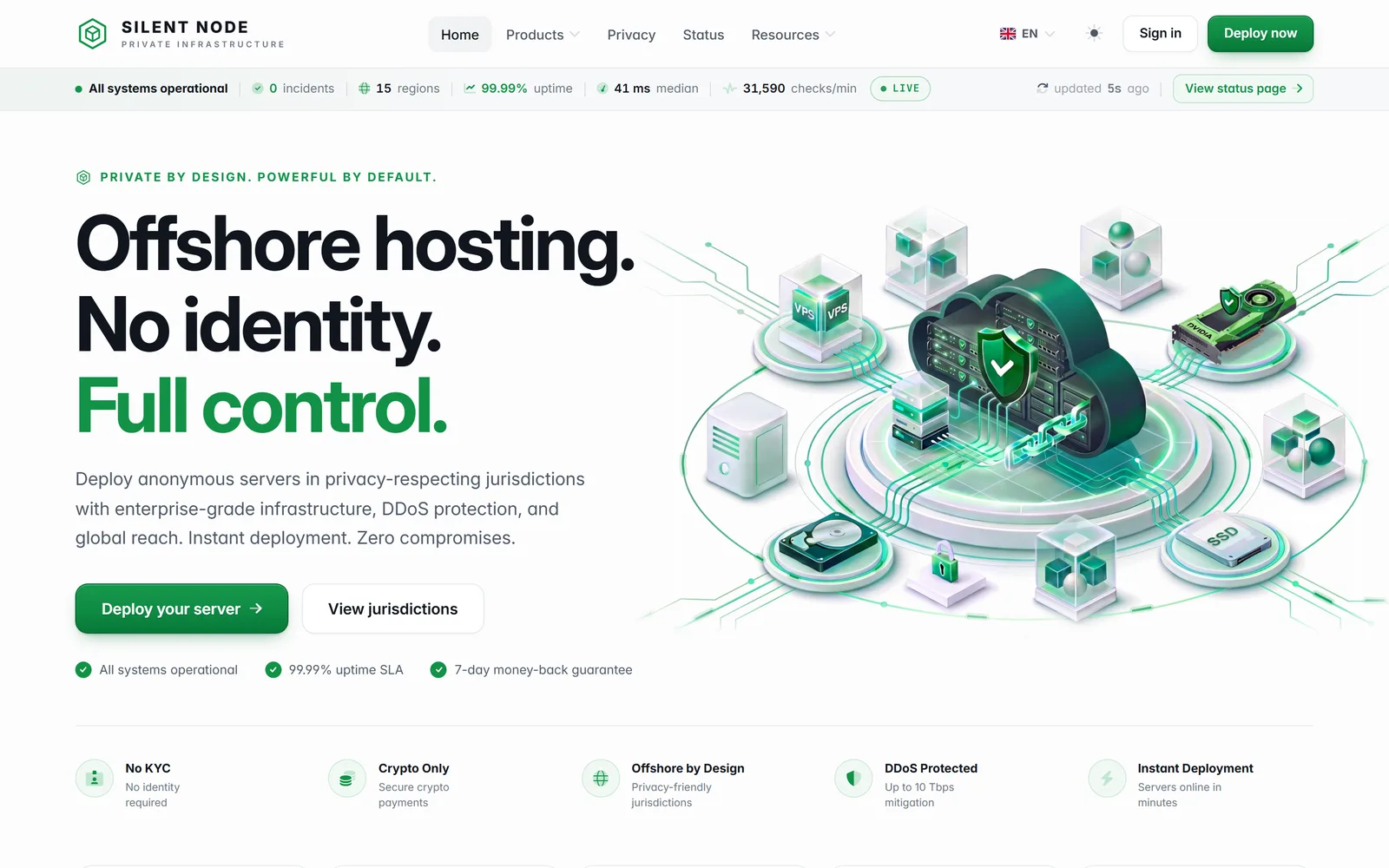
The About page dates the climb: crypto-only billing in September 2021, four jurisdictions by March 2022, the 10 Tbps anycast DDoS backbone in June 2023, Hong Kong completing 12 jurisdictions in February 2024 alongside the 10,000th server, and the status platform, API v1 and monthly canary cadence from January 2025.
Everything runs on hardware the company owns rather than resells: AMD EPYC with local NVMe in hardened racks, peered at AMS-IX, DE-CIX and LINX plus private interconnects. Every VPS plan is deployable in all 15 jurisdictions, none of them in the Five Eyes or Western Europe: Iceland (REK-1), the Netherlands (AMS-1), Switzerland (ZRH-1), Romania, Bulgaria, Moldova, Russia, Georgia, the UAE, Singapore, Hong Kong, Cambodia, the Seychelles, Belize and Panama, with one-click migration between regions. The official guidance is direct: Netherlands, Switzerland or Romania for European performance, Russia, Panama or the UAE for crypto payments, Cambodia, the Seychelles or Belize for anti-DMCA workloads, Iceland, Bulgaria or Georgia for balance, Singapore or Hong Kong for Asia. GPU capacity sits in Amsterdam, Bucharest and Tbilisi, with Tbilisi priced lowest on energy costs. Object storage spans 8 regions. A 99.99% SLA applies to all plans, there are no setup fees, and a 7-day refund guarantee covers new orders.
Privacy & KYC
The account system is the cleanest implementation of no-KYC in this directory. Registration is one click that generates a 16-digit token: no name, no email, no phone number, no identity document, not even a password. The server stores only an irreversible fingerprint of that token, plus the balance and ledger, plan, region, assigned IP and open tickets. Connection logs, traffic logs, IP history and timestamps are never stored, and there is no content inspection. The company's own summary is blunt: "Nothing to hand over." The FAQ explains the absence of Western Europe as deliberate design, since data retention and identification obligations there are incompatible with a no-logs service.
The claim is backed by evidence rather than marketing. A PGP-signed warrant canary has been re-signed on the first of every month since January 2025, and the August 1, 2026 canary reports 0 NSLs, 0 gag orders, 0 warrants and 0 interception equipment. A public transparency register records 41 requests with 0 disclosures in 2024, 67 with 0 in 2025, and 38 with 0 in the first half of 2026. DMCA takedowns are not processed, Tor exit nodes and VPN endpoints are explicitly welcome, and abuse rules are kept short and precise, with spam and email abuse relaying refused.
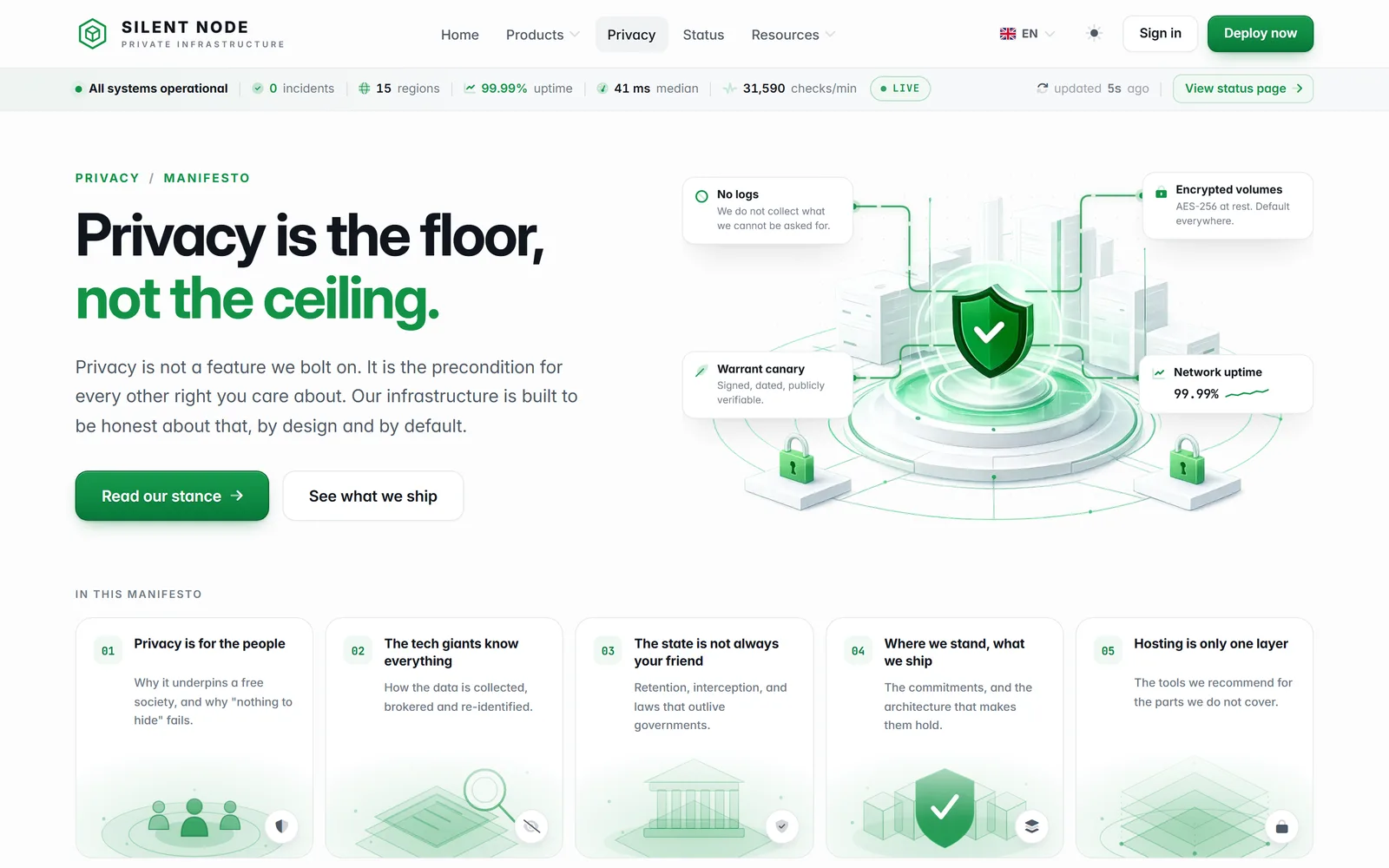
The five-section privacy manifesto reads like a position paper. It invokes Article 12 of the UDHR for journalists, organizers, whistleblowers, doctors and publishers, names data brokers Kochava, Veraset, Cuebiq and X-Mode alongside the FTC's 2022 Kochava action, and cites the de Montjoye 2013 finding that 4 spatio-temporal points re-identify 95% of people and the Rocher 2019 result that 15 attributes reach 99.98%. It notes Meta Pixel on a third of the top 100,000 sites, Acxiom's roughly 1,500 attributes on some 200 million Americans, and Michael Hayden's line "We kill people based on metadata." It closes by recommending Mullvad, IVPN, Tor, Signal, Mullvad Browser, KeePassXC, Bitwarden and Monero, tools the company does not own and earns nothing from.
Supported assets & payments
Payment is crypto only, across 28 coins, with Monero recommended and Bitcoin, Litecoin, Ethereum, USDT TRC-20, USDC, Solana, Dash, Zcash, TRX, Bitcoin Cash and Dogecoin among the accepted list. The model is prepaid: you top up a balance, renewals debit from it, and credit never expires, with a runway counter shown in the dashboard. Deposit addresses are single-use with QR codes, and the docs state confirmations credit automatically in roughly 2 minutes for XMR, 1 minute for USDT TRC-20 and 10 minutes for BTC. Overpayments are credited to the balance rather than lost.
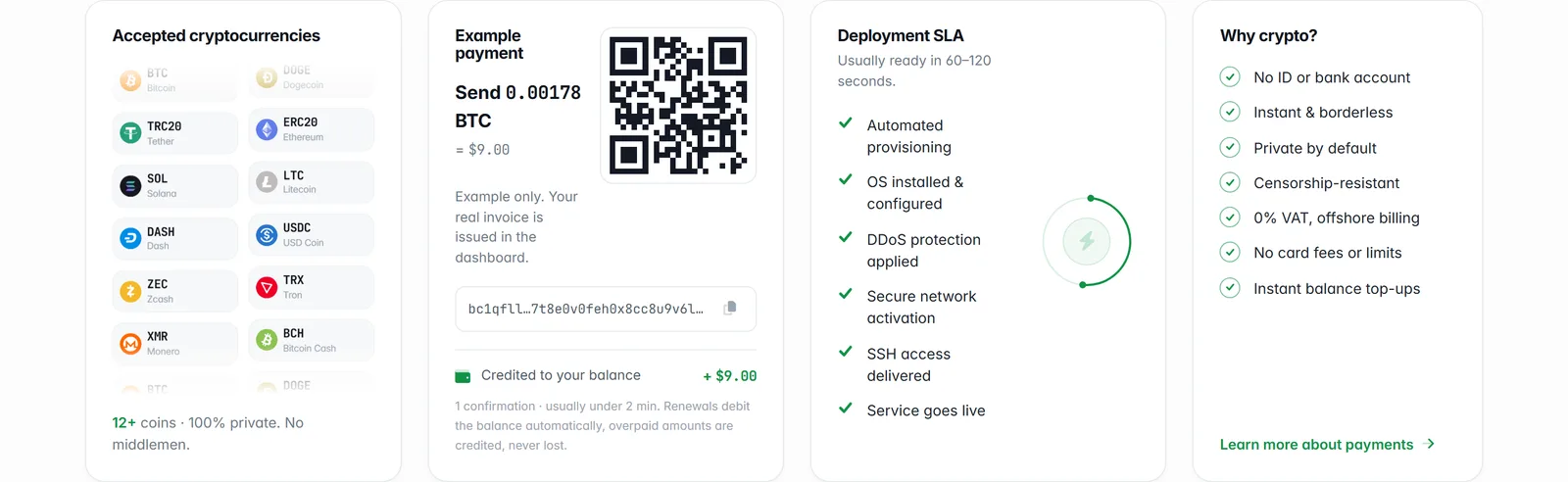
Deposit bonuses exist, but the site is inconsistent about the tiers. The docs describe +10% at $50, +15% at $100, +20% at $250 and +100% at $1,000, while the home banner advertises more generous promotional steps, so the safe summary is a deposit bonus of up to +100% depending on amount and current promotion. Invoices carry no name, and billing is offshore at 0% VAT. There is no card option, no processor-managed subscription and no external auto-charge of any kind. Operational hygiene is thoughtful: tokens can be rotated, active sessions are listed and revocable, and the docs encourage multiple accounts to compartmentalize projects. The docs spell out the tiers' arithmetic: $250 lands as $300, $1,000 as $2,000.
Security & custody
Every volume is encrypted with AES-256 at rest by default, and VPS customers can opt for LUKS with their own key. Object storage applies erasure coding strictly inside the region you choose, data is never replicated outside that jurisdiction unless you ask, object lock provides WORM retention, and versioning and presigned URLs are supported. Object lock makes that WORM retention tamper-proof for the window you set. DDoS mitigation is anycast and included up to 10 Tbps on every plan, always on, scrubbed at the edge before traffic reaches the server. What Silent Node stores is a short, published list: the token fingerprint, balance and ledger, plan, region, assigned IP and open tickets. Everything else, the token itself, any identity, connection logs, IP history, is not stored.
The team is anonymous but not absent: @kern founded the infrastructure side, @aria runs network, @moth handles security and audits, and @fen fronts 24/7 PGP-first support through live chat, tickets and email answered in under 2 hours, with a published support key. The stated limits are plain: no shared hosting and no overselling, no managed services, no macOS instances, automatic backups are a paid add-on (encrypted, kept in-region), maintenance is announced in advance, refunds are refused when abuse rules are broken, and you are responsible for your own data. Lose your token and there is no recovery, by design.
User experience & performance
How this review was built: on 18 August 2026 we crawled every public page of silentnode.host, product pages, the five docs chapters, the privacy manifesto, the live status page, the API reference and the 4,400-page tutorial library, pulled the public status API, read the canary and transparency ledger pages, and compared the price grid line by line against every other hosting listing in this directory. We rented and measured nothing; performance figures here are the provider's own published telemetry.
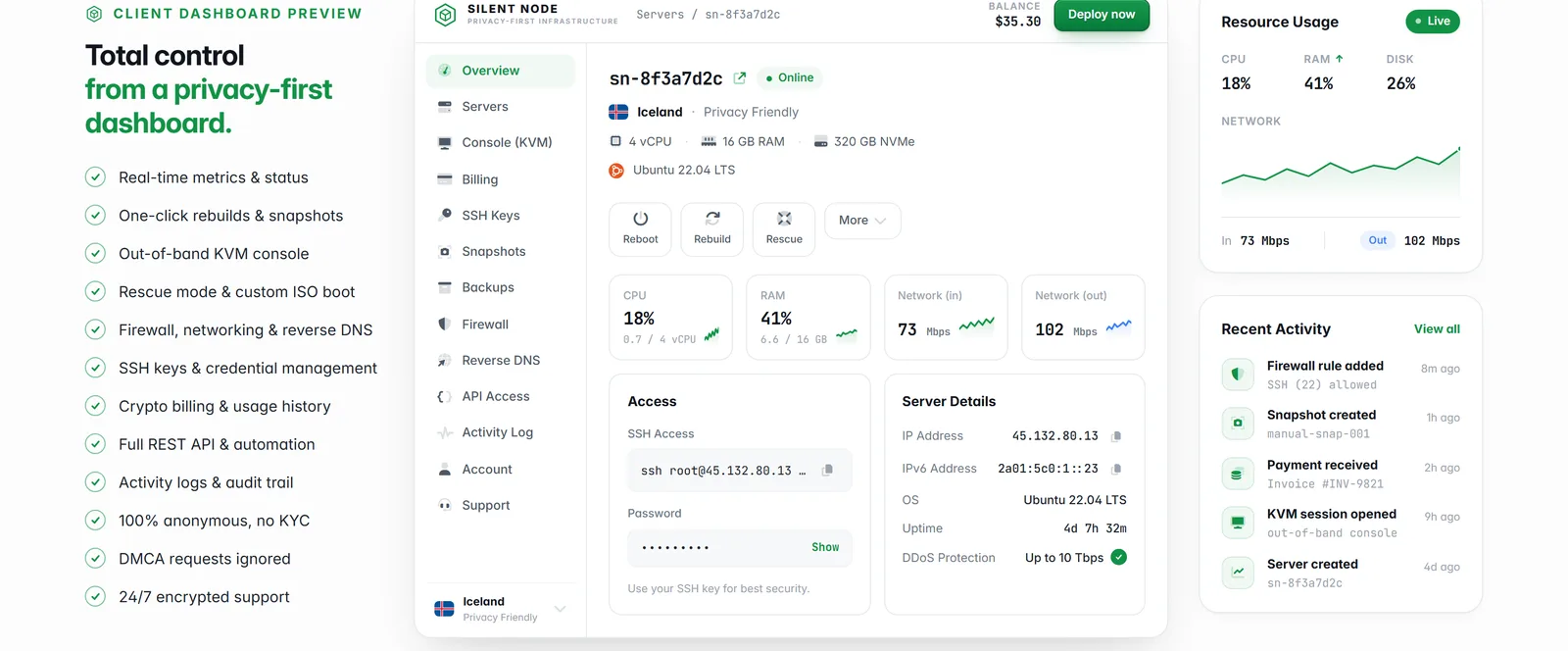
The VPS line runs dedicated threads that are never oversubscribed, with local NVMe inside the host. Instances go live in 1 to 2 minutes, resize without downtime while keeping IP and disk, and ship with IPv4 plus a /64 of IPv6, reverse DNS, private VLANs, snapshots, web console and out-of-band KVM, rescue mode, custom ISOs, 60-second reinstalls, live monitoring and an IP/ASN firewall. Windows is available with RDP included. A REST v1 API at api.silentnode.io covers 100% of the panel, with curl, Python, Go and PHP SDKs, webhooks and documented rate limits. Dedicated machines use EPYC 4004 and 9004 series CPUs with DDR5 ECC throughout and Gen4 NVMe, are hand-racked with burn-in and link tests, and are delivered in 4 to 12 hours with IPMI and KVM over IP, custom ISOs and extra IPv4 at $1 each. Boost clocks run high: 5.1 GHz on the 4244P, 5.3 on the 4344P, 5.4 on the 4464P, 5.7 on the 4564P and 4584PX, 2.9 to 4.15 GHz on the 24-core 9254.
- VPS: Starter at $6.99 (2 vCPU, 2 GB RAM, 80 GB NVMe, 10 TB transfer), the most-chosen Pro at $22.99 (6 vCPU, 8 GB, 320 GB, 20 TB), up to Titan at $119.99 (32 vCPU, 64 GB, 2 TB, 5 Gbps port)
- Dedicated: Iron at $64.99 (EPYC 4244P, 6c/12t, 32 GB, 1 TB), the most-chosen Steel at $84.99 (EPYC 4344P, 8c/16t, 64 GB, 2 TB), up to Titan at $219.99 (EPYC 9254, 24c/48t, 192 GB, 8 TB), all on 10 Gbps unmetered with options beyond on quote
- GPU: RTX 4090 at $0.18 per hour ($99 per month reserved), RTX 5090 at $0.32, L40S at $0.39, A100 80 GB at $0.59, H100 at $0.74, up to B300 288 GB at $1.23 ($700 reserved), with monthly reservations cutting roughly 35 to 45% and yearly a further 20%; billing stops when the instance stops, the NVIDIA R580 driver comes preinstalled with optional CUDA 13, NVLink on supported cards, unmetered transfer, persistent volumes discounted at 1 TB and 8 TB, and a per-checkpoint configurator that maps an LLM to the cheapest node that holds it; per the provider, nothing is retained, no prompts, no weights, no telemetry
- Object storage: 250 GB at $4.99, the most-chosen 1 TB at $14.99, up to 10 TB at $109.99 per month, across 8 regions, where the chosen region fixes the legal venue of the objects
Card by card: the 24 GB 4090 ($0.18/h) suits lighter inference, the 32 GB 5090 ($0.32) and 48 GB L40S ($0.39) cover mid-size serving, the 96 GB RTX PRO 6000 ($0.53) nears 100 GB without HBM pricing, the A100 ($0.59) and H100 ($0.74) are the NVLink workhorses, and the B200 ($0.98), H200 ($1.04) and 288 GB B300 ($1.23) top the bench.
The public status page carries the motto "Don't trust us. Verify" and publishes live metrics through a status API: about 31,600 checks per minute, probes every 30 seconds, 4 per site, a 30-day weighted uptime of 99.99% and component figures between 99.98% and 100%. Per the status page, median latencies run 27 to 28 ms in Amsterdam, 29 ms in Zurich, 33 ms in Reykjavik, 43 ms in Singapore, 73 ms in Phnom Penh and 80 ms in Belize, with packet loss between 0.01% and 0.03%, and a full incident history is posted. A tutorial library of more than 4,400 pages in 26 languages covers security, containers, databases, networking, devops and LLM topics such as vLLM, quantization and batching.
Who it's for, verdict
Silent Node is built for journalists, organizers, whistleblowers, doctors, publishers and anyone whose threat model starts at identity collection, and it displays logos from Proton, Tutanota, IVPN and n8n under "trusted by privacy-focused teams". The cons are real: a lost token is a lost account with no recovery path, crypto is the only way to pay, nothing is managed for you, backups cost extra, and the company behind it is a young, anonymous team founded in 2021.
Verified against this directory's own listings on 18 August 2026: every other hosting listing spans one to five jurisdictions (servers.guru claims ten datacenters), so fifteen regions across four continents is the widest jurisdiction map in this category, and nobody else pairs it with one-click migration. None combines a monthly signed canary with a public request ledger and a live status API, a transparency stack we have not seen matched by any other listing here. Nine GPU classes up to 288 GB, billed hourly, is the deepest GPU bench in the category.
Even with those caveats, this is the strongest entry in the directory and the new reference for no-KYC infrastructure. No other host reviewed here pairs a token-only account system with a monthly signed canary, a public zero-disclosure ledger spanning 2024 through mid-2026, 15 non-Five-Eyes jurisdictions, owned EPYC hardware peered at AMS-IX, DE-CIX and LINX, a 10 Tbps anycast shield and GPU pricing from $0.18 an hour, all under a 99.99% SLA with a 7-day refund guarantee. Rivals in this list match one or two of those properties. None match all of them. If you need infrastructure where the provider structurally cannot identify you, Silent Node is the one to pick, and the one the rest of this directory is now measured against.